
How to Get Court Records
Start with Indiana MyCase to identify a public case, its Wabash court, and the precise document or CCS event needed. Then choose the appropriate local channel. The Clerk counter handles Circuit and Superior files; Wabash City Court should confirm its own 85H01 material. A requester seeking certification or an unavailable document should not rely on a portal printout.
- Identify the court, case number, approximate year, and exact record or docket event.
- Check MyCase for a public image or visit the Clerk at 69 W Hill Street for inspection.
- Call 260-563-0661 before mailing or traveling, especially for historical research.
- Email the Records Department or mail a written request with names, years, record type, and contact details.
- Wait for the quoted cost, then follow the Clerk's payment and return-envelope instructions.
- Say explicitly whether a plain copy or certified copy is required.
The 69 West Hill Records Counter
The Clerk of the Circuit and Superior Courts is on the first floor of the Judicial Center at 69 W Hill Street, Wabash, Indiana 46992. Published public hours are 8:00 a.m. to 4:00 p.m., Monday through Friday. Circuit Court itself is listed at 49 W Hill and Superior Court at 59 W Hill, so a visitor should use the address printed on a notice and ask which counter holds the requested item.
Wabash County Clerk
69 W Hill Street, first floor
Wabash, IN 46992
260-563-0661 or 800-286-3190
Records Department extension 1235
The office publishes no guaranteed turnaround, request tracker, appointment calendar, or separate court-copy cutoff. The correct step is to describe the record and ask the Clerk for the current process.
Types of Court Records
The unified Clerk manages county trial-court filings across several case categories. Availability depends on the record, case type, age, and access rule. A public CCS entry can identify a document without making its image downloadable.
- Case Summaries and Chronological Case Summaries
- Pleadings, motions, answers, service returns, and attachments
- Signed orders, judgments, commitments, warrants, writs, and protective orders
- Criminal, civil, family-relations, probate, estate, and small-claims files
- Plain copies, certified documents, judgment transcripts, and hearing transcripts
Writing a Wabash Records Request
The official genealogy and research page gives a practical written-request route.
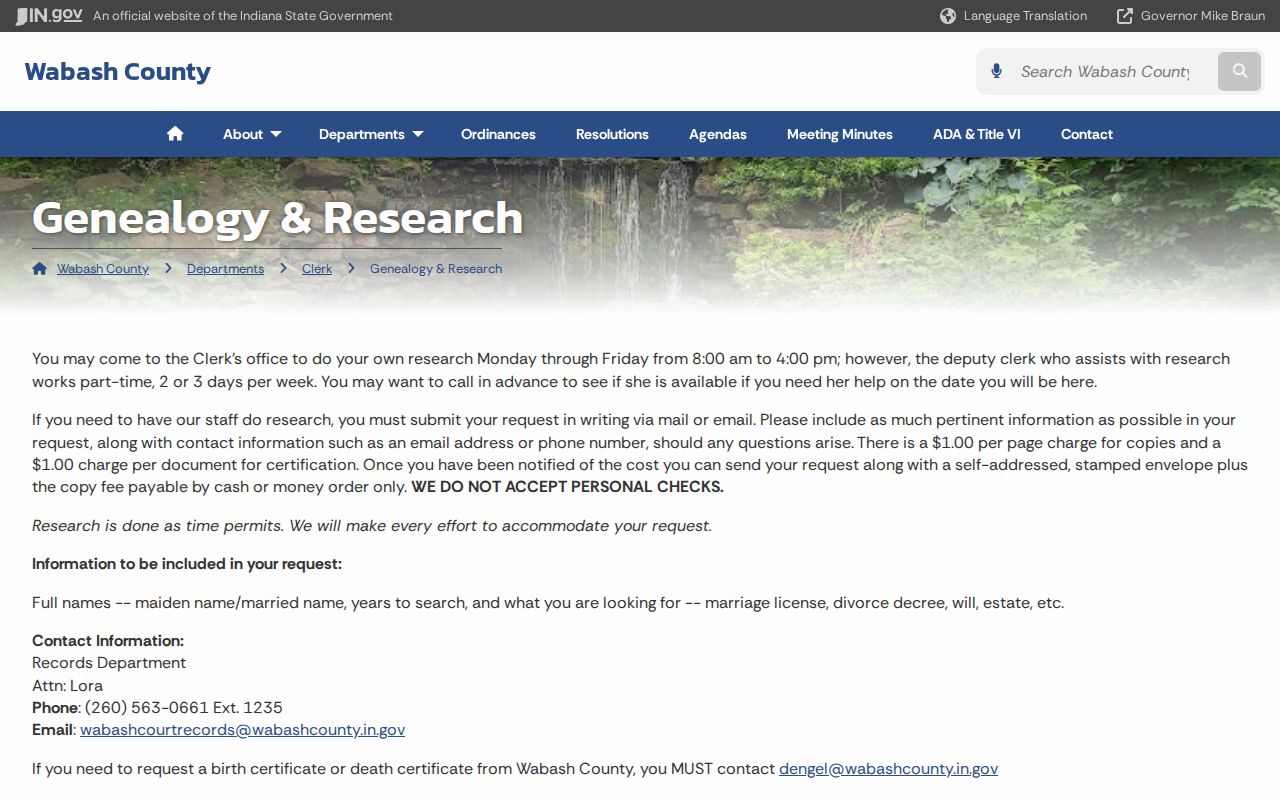
Send full names, maiden or married names when relevant, approximate years, the record sought, and a phone or email contact to wabashcourtrecords@wabashcounty.in.gov or the Records Department, Attn. Lora, at the Clerk address. The office first reports the cost. Its instructions call for a self-addressed stamped envelope and cash or money order, with no personal checks. Do not email payment-card data.
What a Court Record Contains
A case file is broader than its online docket. The Case Summary identifies the proceeding and the CCS indexes activity in date order. The underlying file may contain the actual pleadings, signed orders, exhibits, returns, and other documents, subject to exclusions and redaction. A hearing transcript is a separate court-reporter product, not another name for a docket copy.
| Case Number | Wabash identifier such as 85C01, 85D01, or 85H01, plus case type and sequence. |
|---|---|
| Pleadings | Petitions, complaints, motions, answers, and filed attachments. |
| Orders & Judgments | Signed rulings and disposition documents available to the requesting audience. |
| CCS | The dated index of filings, settings, orders, and other case events. |
| Exhibits | Filed evidence or attachments when retained and publicly accessible. |
| Financial Entries | Public assessments and transactions; confirm the current official balance with the Clerk. |
Library Access and Older Holdings
Wabash local rules identify Wabash Carnegie Library and North Manchester Public Library as electronic research facilities, subject to their own rules and fees. The rule does not promise that library access reveals more than MyCase or that library staff can certify a record. Certification remains a Clerk function.
Historical gaps have local context. A courthouse fire in 1870 destroyed many early records, although records held by the clerk, treasurer, auditor, and recorder were among the reported survivors. The Indiana State Library's Wabash research guide helps identify archival alternatives.
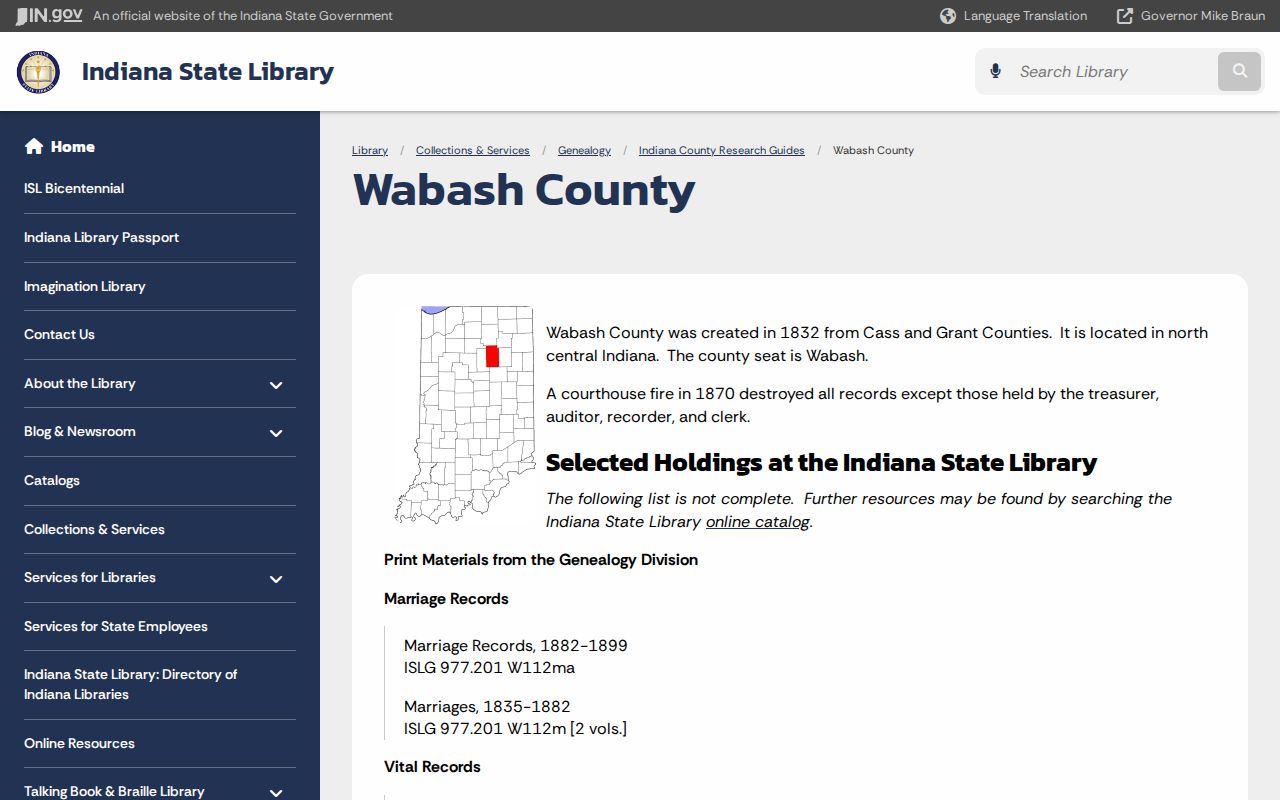
An older-file search should therefore combine MyCase, the Clerk, the two named library facilities, and state archival guidance rather than treating an empty portal result as final.
Certified Copies and Fees
A plain copy reproduces the requested page. Certification adds the Clerk's formal authentication to a document. A judgment transcript and a verbatim hearing transcript are different products with distinct fees. State limits and the Wabash research page provide the amounts below; ask the Clerk to quote the exact request before sending payment.
| Item | Amount |
|---|---|
| Plain court-record copy | Not more than $1 per page |
| Staff historical-research copy | $1 per page |
| Certification | $1 per document |
| Judgment transcript | $3 |
| Private-party hearing transcript | $5 per page, $35 minimum |
| Expedited transcript surcharge | $1 per page when completed within ten days |
Clerk of the Circuit and Superior Courts
69 W Hill Street
Wabash, IN 46992
260-563-0661
Payments Are Not Record Certification
The Clerk routes traffic and some criminal payments to the state service and other case payments to GovPay. The observed Wabash GovPay form asks for a case-number prefix, payer name, case number, amount, billing details, and card information.
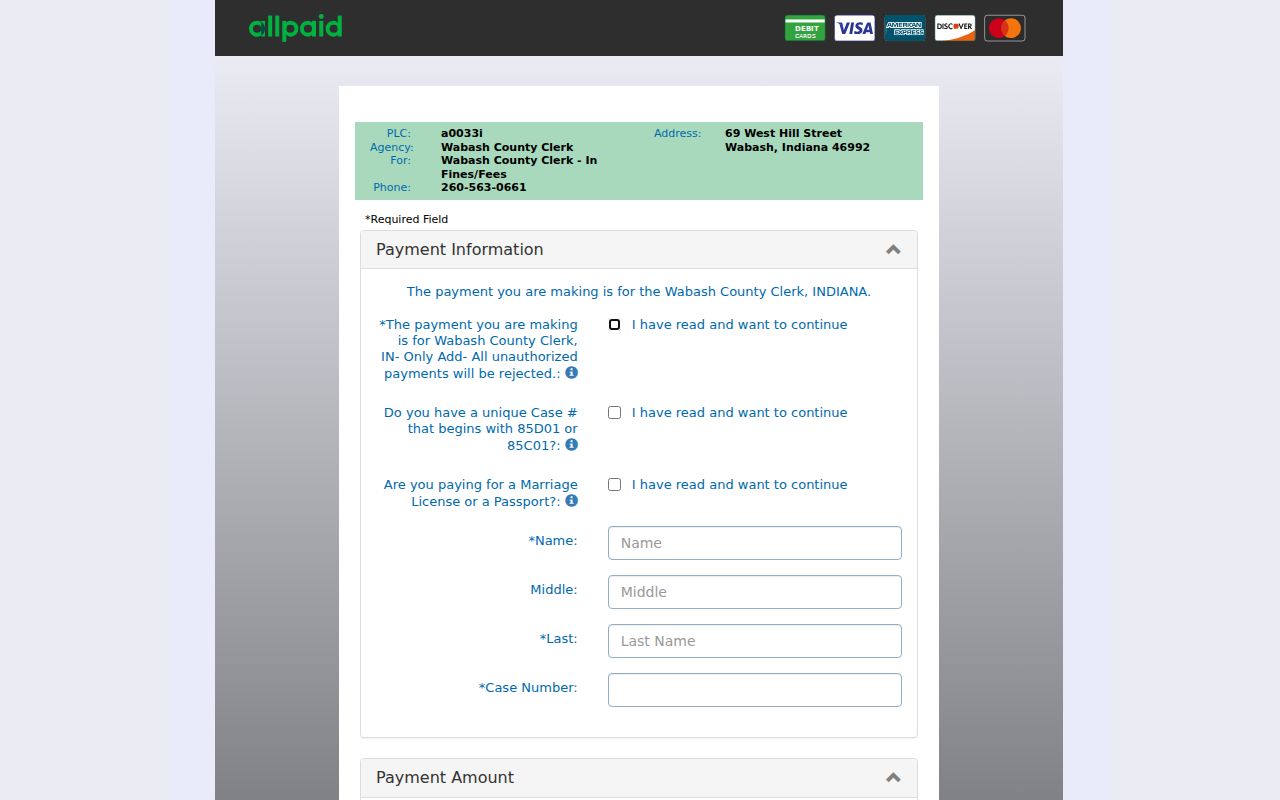
A payment confirmation does not certify a court record or establish that a displayed balance includes later interest and charges. Obtain the Clerk's official balance and receipt when proof matters. The inspected form did not display a Wabash-specific processing fee, so the amount should be checked before payment.
Public Access and Sealed Records
Indiana court records are governed primarily by the Indiana Rules on Access to Court Records. Rule 4 creates the public-access presumption, Rule 5 excludes specified information, and Rule 9 provides a procedure for requesting access beyond the ordinary public view. Sealed, expunged, juvenile, mental-health, protection-order, and personally identifying information can be restricted. Indiana's Access to Public Records Act, IC 5-14-3, may apply to administrative records, but it does not erase court-record confidentiality.
Key Rules:
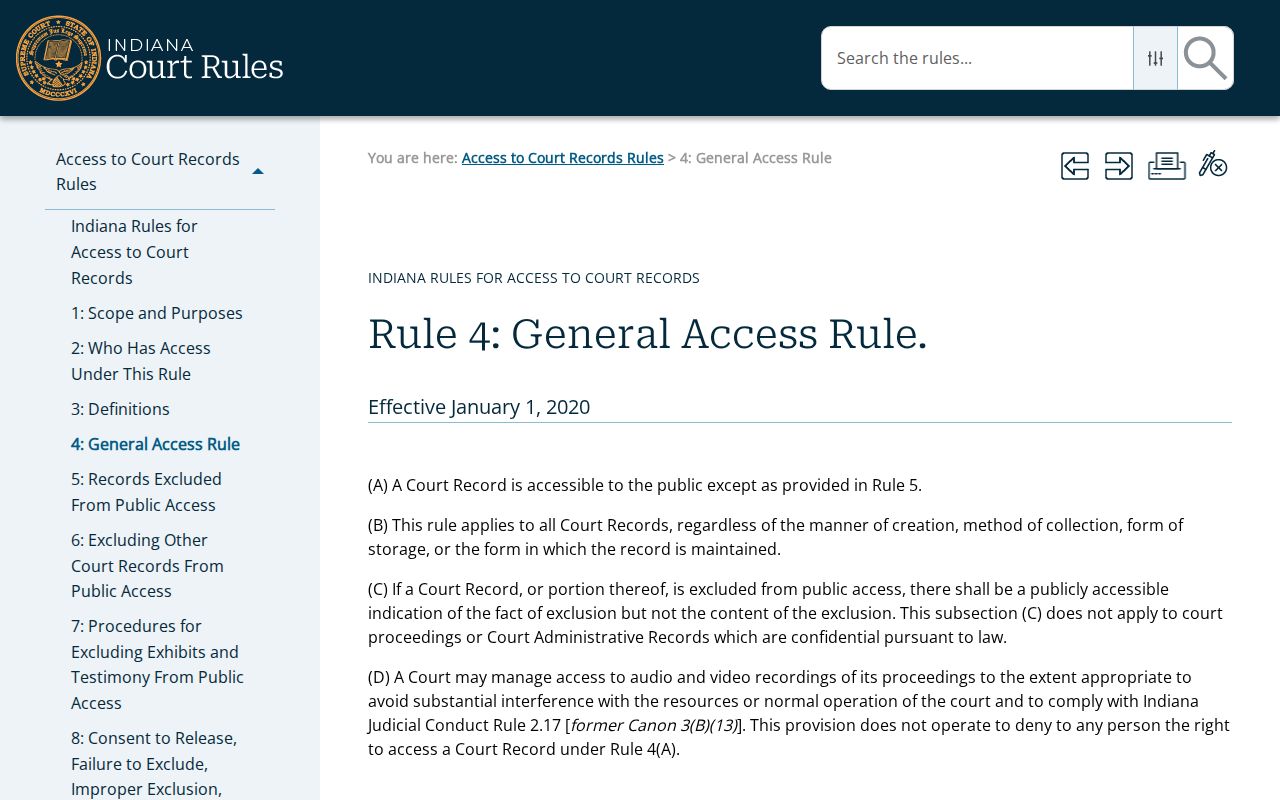
Access Rule 4 states the general public-access presumption.
Access Rule 5 identifies court records excluded from public access.
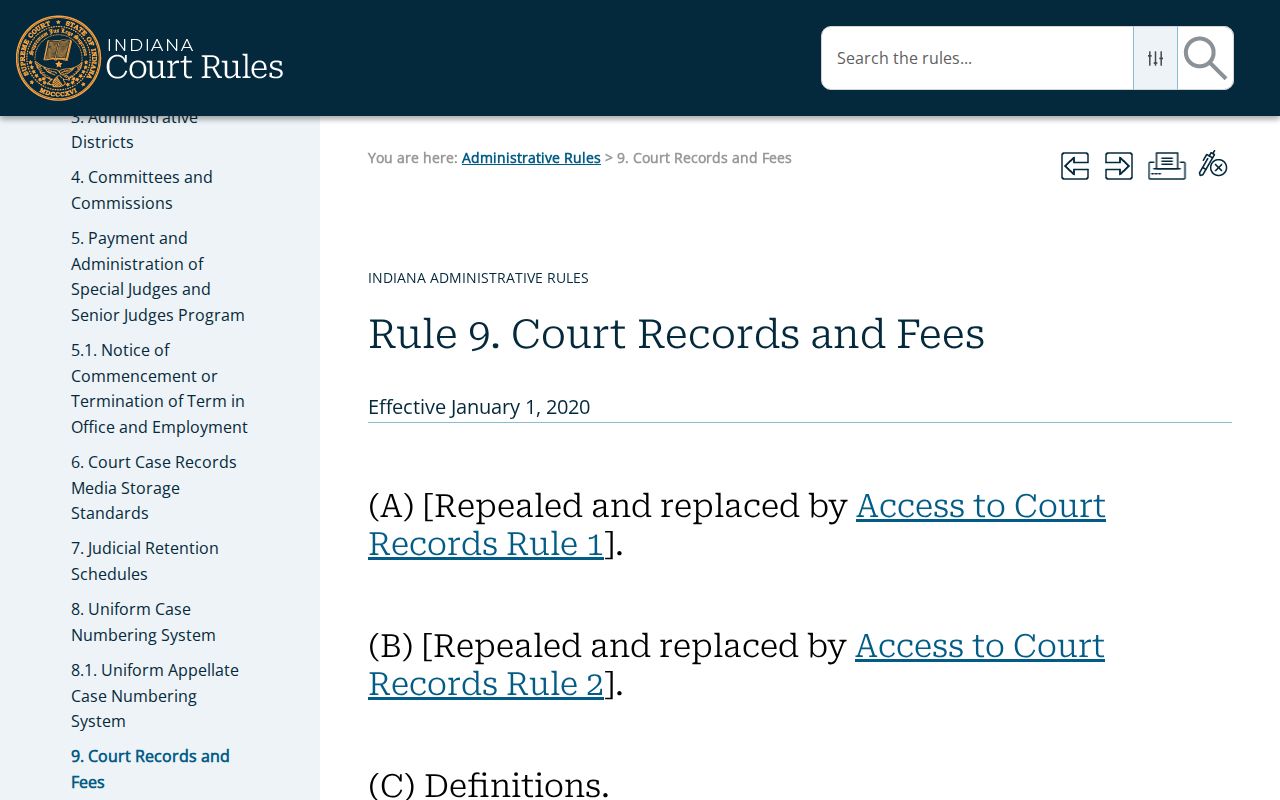
Access Rule 9 provides the request procedure for extraordinary access.
The state access-rules collection places those rules in context.
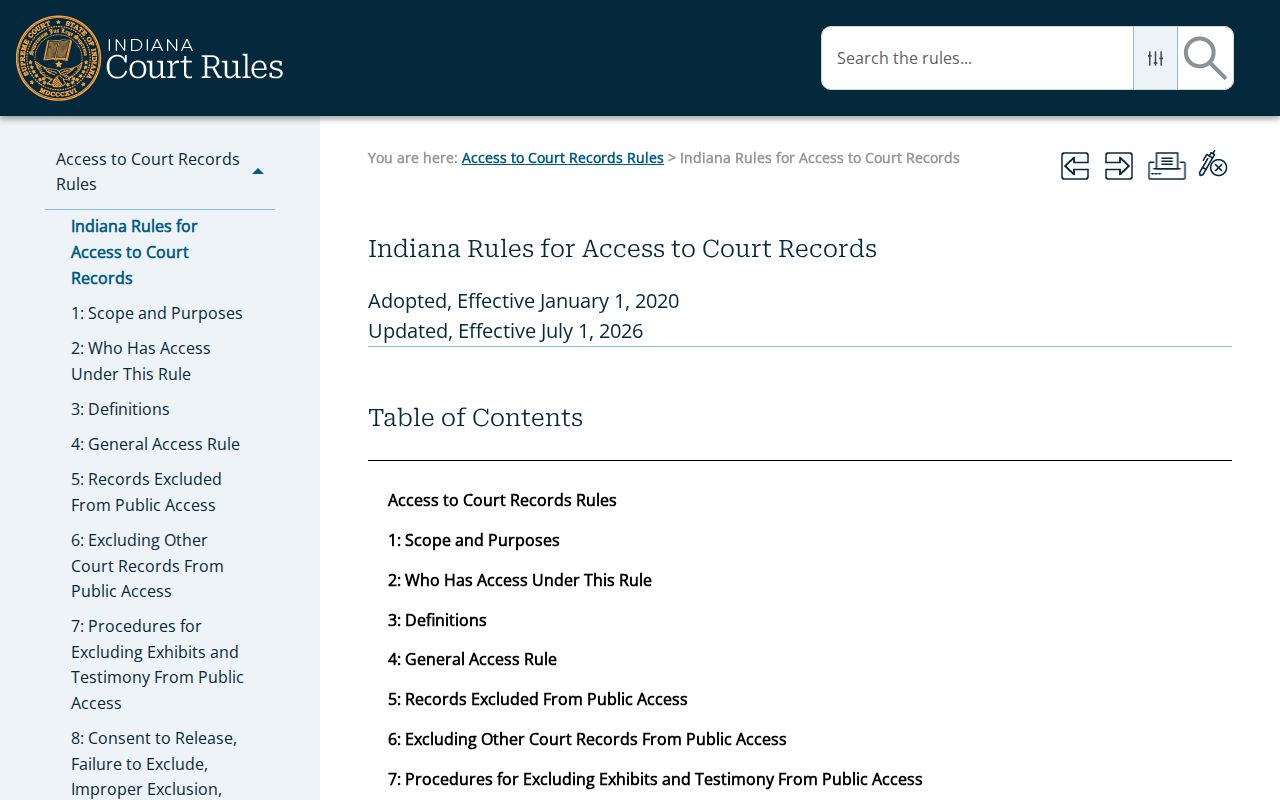
Rules 4 and 9 are also documented in the assigned local research images below, showing why remote availability and lawful access are related but not identical questions.
Rule 4's official text sets the starting presumption.
Administrative Rule 9 addresses remote access in the statewide system.
When access is denied or an image is absent, identify the exact item and ask the record-holding court which rule and request path apply.
The Part-Time Research Schedule
The Clerk's research deputy is available only two or three days per week. Ordinary office hours do not guarantee that the staff member who performs historical research will be present. Call extension 1235 before traveling, especially when the request involves a broad year range, name changes, probate material, or an older file.
Personal research is allowed during regular weekday hours, but the county publishes no terminal count, guaranteed staff-assistance promise, or copy-production time. Bring the case number when known and separate the inquiry into specific documents. For mail research, wait for the cost notice and return instructions rather than sending an estimated amount.
The 2025 Retention Review
Wabash County published a 2025 records-retention notice and agenda. It shows that local record management occurs through a public process, but it does not prove that any particular court file was destroyed. A missing online image should be checked against the Clerk's holdings, retention schedule, conversion history, and archival routes before drawing a conclusion.
Provide the case number, court, record title, and approximate filing date when asking about retained material. Those details let the custodian distinguish an unavailable public image from a transferred, archived, excluded, or lawfully disposed record. The county's lack of a public request tracker means direct confirmation is particularly important.
Electronic availability also reflects Wabash's technology timeline. Circuit and Superior Court entered Odyssey in September 2018, while City Court entered in February 2023. Converted records may contain useful index data without every older image. The Clerk can explain whether the requested item remains paper, microfilm, converted data, or a restricted electronic document.
The 2025 notice should be read as records-management context, not as a substitute for a case-specific answer. Retention categories, court orders, archival transfers, and confidentiality rules can affect different materials in different ways. Asking about one identified document gives the custodian enough information to check the correct schedule and storage location.
Always retain the Clerk's written cost and availability response with the resulting copy.